Donating Coins to the Liberty Seated Collectors Club?
(Always consult your tax professional when considering a charitable contribution!)
While tax-deductible contributions of cash can always be made to the Liberty Seated Collectors Club, you may want to consider donating a portion of your collection. Under the right circumstances, doing so can create significant tax advantages. This article, originally published in April of 2026, addresses the sometimes-confusing aspects of why and how to donate everything from a single coin to an entire collection to LSCC.
Why should I consider donating coins to the Liberty Seated Collectors Club?
- First and foremost, donating coins to LSCC supports our long-term mission; to enhance numismatic education and advance the study and appreciation for the coins of Christian Gobrecht.
- Avoiding capital gains taxes. If you own coins that have enjoyed significant appreciation, the sale of those coins would normally trigger a tax liability. Adding insult to injury, as of this writing, coins and collectibles have an unusually high capital gains tax rate; as high as 28%. Add in the Medicare 3.8% surcharge and possible state taxes and the tax can amount to a considerable chunk!
- By donating coins you may receive a charitable tax deduction, reducing your taxable income.
- Depending upon your “age and stage” donating some of your coins can be an effective way to reduce your taxable estate.
What are the required administrative procedures to donate coins?
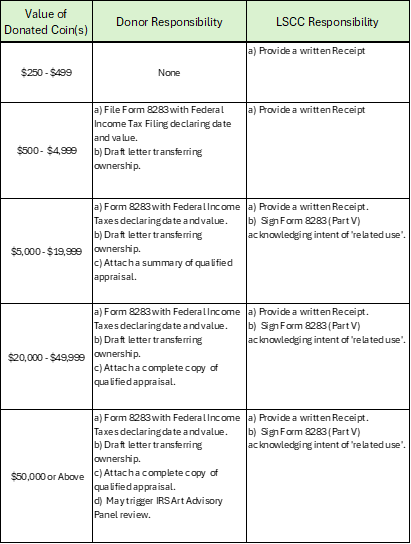
First off, it's important to discuss any contribution plans with the Liberty Seated Collectors Club to ensure the club is willing and able to accommodate your giving plans. Secondly, you'll want to create a letter of agreement between yourself and LSCC to document the transfer of ownership. Third are the requisite IRS reporting forms. The table below summarizes the administrative responsibilities of both the Donor and LSCC for a donation of coins:
What does the required “qualified appraisal” for coin donations above $5,000 entail?
The purpose of a qualified appraisal is simply to ensure the value of the contributed coin(s) is in the ballpark of what the donor is claiming. The appraisal itself should include:
- Detailed description of the item(s) including country of issue, denomination, date, mint, grade, TPG information.
- Digital, or actual photo of the coin(s).
- Fair market value as of the date of donation based on industry publications, auctions results, etc.
As to the Appraiser:
- The appraiser must be qualified (verifiable education or professional experience) and be independent of the donor. (An arm's length relationship.)
If I contribute six $1,000 coins to LSCC, would that avoid the qualified appraisal requirement?
Probably not. If the coins are all of a similar nature, or derived from the same collection, the IRS aggregates your gifts, which would require an appraisal of the six coins.
My coin(s) have appreciated in value. Can I deduct the current market value?
A donor can deduct the market value for donated coins, versus their often-lower cost basis so long as the following conditions are met:
- The coin(s) have been held by the donor for 12 months or longer.
- LSCC can use the coin(s) to further its charitable purpose. [What the IRS refers to as “related use” – Section 170 (e) (1) (B) (i)]. For example, if the donated coin(s) can be displayed at coins shows, furthering our educational mission, that would qualify. But if instead you chose to donate the coins to your local food bank, that wouldn't further the food bank's mission, and so the donor could only deduct the lessor of the cost basis or the current value.
A counterintuitive (frustrating) requirement, even if circumstances only allow you to deduct the cost basis of the coin(s) you're contributing, if the current value is above $5,000., you still need to obtain the qualified appraisal – even if you're not really using it.
What if LSCC auctions my coins and buys coins with a LSCC related use. Would that qualify for a market value tax deduction?
Probably not. The IRS has taken the view that “auctions” are not a charitable organization's primary charitable purpose, which would apply to LSCC, or even the ANA, ANS, etc. The donor in this example should deduct the lessor of the coin(s) cost basis or current market value.
Is there a dollar limit to how much I can donate?
There is no dollar limitation on the amount you can donate, but there are limits to how much you can deduct from your taxable income in any given year. If you donate coins that meet the holding period requirement and further LSCC's charitable purpose, the most you could deduct from your taxable income would be 30% of your Adjusted Gross Income (AGI). AGI is total income less above-the-line adjustments, or Line 11 on your 2025 Federal 1040 Tax Form.
However, if your donation was greater than 30% of your AGI, your excess deduction can be carried forward up to five years to offset future income. (There are two minor modifications to this rule taking effect in 2026 specifically for very high-income earners. Yet another reason to touch base with your tax professional.)
What if LSCC sells some or all of my donated coins within the next 3-Years rather than displaying them?
If LSCC sells your coin(s) within three years of your gift, it is the responsibility of LSCC to file IRS Form 8282, which identifies the donor and the original date of the gift. The donor would then have the responsibility to revise their charitable donation valuation down to their cost basis.
Any exceptions to this 3-Year lookback rule?
Yes, although a somewhat obscure one. If within the 3-year period, LSCC submits a written statement “under penalty of perjury,” to the IRS, saying that it had become “impossible” to continue using the coin(s) for a related use, along with the evidence of why it was impossible, the IRS will not look to the donor to recapture the difference in cost vs market deduction. [Section 170 (e) (7) (D)].
What about bullion coins that have legal monetary status in their country of origin, such as Maple Leafs or American Eagles? Can I deduct the current market value if I contribute them to LSCC?
This is the grayest of gray areas. IRS formal regulations do not specifically address this issue. There was a Private Letter Ruling (PLR#9225036) stating that Krugerrands and Maple Leafs were equivalent to cash and thus circumvent all the various requirements to deduct market value vs cost basis. However, Private Letter Rulings are purposely very narrow, and to this author's knowledge the IRS has not specifically ruled in regard to American Eagles.
I'm a licensed coin dealer. If the 12-month holding period and related use requirements are met, can I deduct the market value of donated coins?
The IRS views a dealer's coins as business inventory, and eventually subject to regular business income tax, not capital gains taxes. As such, a dealer contributing rare coins to LSCC would only be able to deduct the lessor of the coin's cost basis, or their current market value. (And obviously a dealer isn't permitted to do their own qualified appraisal.)
Please contact us if you wish to consider a charitable contribution of coins. We cannot give tax advice, but we can let you know if what you're considering would be feasible from the standpoint of the Liberty Seated Collectors Club.
| Contact: |
Jeff Pritchard, LSCC Secretary
JJPSR2@gmail.com |
The above is for informational purposes only. Everyone's financial, tax and family circumstances are unique, so one should always consult with their tax professional when considering a substantial charitable contribution.